How Often You Should Detail Your Car on Long Island
14
Sep
Islip gets measurable rain or snow on about 122 days a year, one day in three, and the two wettest months are December and March, which are also the two months the Town of Islip’s brine trucks are busiest. That is the whole reason a Long Island car needs a different schedule from the one in the owner’s manual. The short version for a daily driver here: a hand wash every 7 to 10 days from the first brine of December through March and every 2 to 3 weeks the rest of the year, a sealant every 3 to 4 months, and a full interior and exterior detail two to four times a year. The rest of this post shows where those numbers come from, what each season actually throws at the paint, what neglect costs in real dollars, and how the schedule changes for dog owners, beach regulars, work trucks, rideshare cars and leases.
Jump to a Section
- ›What the Owner’s Manual Says vs What Detailers Say
- ›The Islip Calendar, Month by Month
- ›Salt Season Starts Before the First Snow
- ›Salt Air Is a Few Hundred Meter Problem, Not an Island Wide One
- ›What Neglect Costs
- ›Schedules by How You Use the Car
- ›Leased Cars: The Credit Card Rule
- ›Signs the Car Is Telling You, Not the Calendar
- ›Which Package Fits Which Visit
What the Owner’s Manual Says vs What Detailers Say
Start with the floor. The Kia owner’s manual tells you to wash the car “at least once a month,” to “hose off the underside of your vehicle at least once a month” in winter, and to wax “when water will no longer bead on the paint.” Hyundai’s manual says the same, almost word for word, and both list “road salts” and “ocean air” as causes of accelerated corrosion. Nissan’s manual calls de-icing chemicals “extremely corrosive” and says to wash salt off “as soon as possible.” That is the manufacturer’s minimum, written for the whole country.
The detailer consensus sits higher. Consumer Reports’ Jon Linkov told ABC7 that washing “is not about doing it on a schedule,” it is about washing when mud, salt and grime appear, with an undercarriage wash once a season, and Consumer Reports has separately put hand waxing at three to four times a year because even good waxes only last a few months. Working detailers on Autogeek describe weekly washes, interior cleaning monthly, and sealant or wax every four weeks to three months. The honest range, then, is monthly at the floor and weekly at the ceiling, and Long Island’s climate is the reason to sit toward the ceiling from December to March.
The Islip Calendar, Month by Month
These are the National Weather Service 1991 to 2020 normals for Long Island MacArthur Airport in Islip, which is the closest official station to most of the towns we serve. The last column is what each month does to a car that lives outside.
| Month | Mean high / low °F | Precipitation, in | Snow, in | What hits the car | Wash interval |
|---|---|---|---|---|---|
| Dec | 44 / 30 | 4.7 (wettest) | 4.5 | First brine, re-wetted by rain | 7 to 10 days |
| Jan | 39 / 25 | 3.7 | 10.3 | Salt, slush, plow grit | 7 to 10 days |
| Feb | 41 / 26 | 3.3 | 9.4 | Salt, lowest temps | 7 to 10 days |
| Mar | 48 / 32 | 4.5 | 6.5 | Last salt, maple and birch pollen begins | 7 to 10 days, then underbody flush |
| Apr | 58 / 41 | 4.1 | 0.6 | Oak pollen peak | 2 weeks |
| May | 68 / 51 | 3.3 | 0 | Oak and grass pollen, first bird season | 2 weeks |
| Jun | 77 / 61 | 4.0 | 0 | Grass pollen peak, UV reaches 8 or 9 | 2 to 3 weeks |
| Jul | 83 / 67 | 3.3 | 0 | Peak UV, beach sand and salt, humidity | 2 to 3 weeks, same day after the beach |
| Aug | 81 / 66 | 4.2 | 0 | Same, plus afternoon storms | 2 to 3 weeks |
| Sep | 75 / 59 | 3.6 | 0 | Ragweed, mold spores after rain | 2 to 3 weeks |
| Oct | 64 / 47 | 4.0 | 0 | Leaf tannin stains, sap | 2 weeks, leaves off within a day |
| Nov | 54 / 38 | 3.4 | 0.5 | Late leaves, first frost, pre winter sealant window | 2 weeks, then seal before December |
Two things stand out. Precipitation is nearly flat across the year, 3.3 to 4.7 inches every month, so there is no dry season where the car can be ignored. And the snow is a December through March event (30.7 of the 31.8 annual inches), which means the salt window is a tight four months and the pre winter sealant has one obvious slot: November, when the mean high is still 54 degrees and the panel is warm enough for the product to bond.
Salt Season Starts Before the First Snow
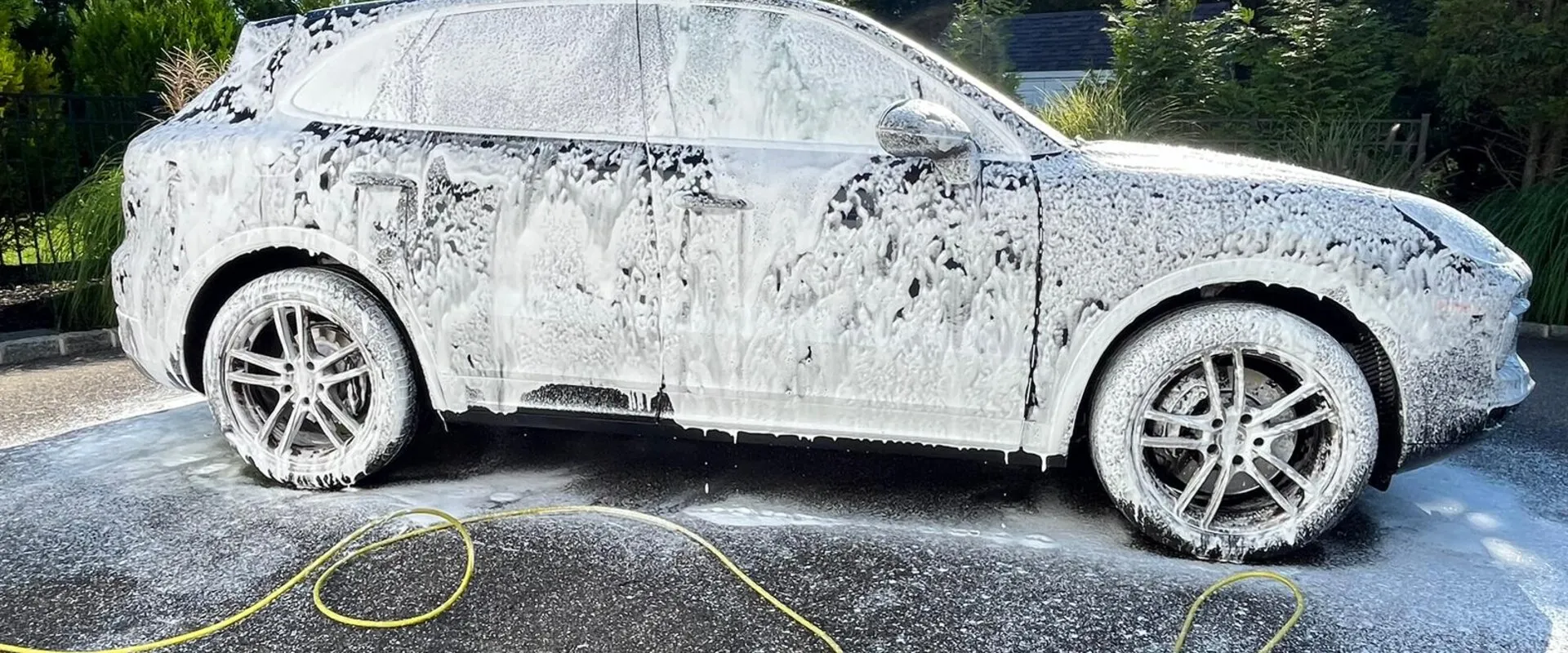
Most people think salt season begins with the first plow. It begins with the first forecast. The Town of Islip’s Highway Division runs two brine making facilities and pretreats roads before storms; Patch reported crews “spreading brine on town roads” the day before a January 2019 storm. Brine is roughly 23 percent salt, it is sprayed as a liquid, and it atomizes onto rocker panels, lower doors, wheel wells and the underbody as you drive through it. It also clings in a way rock salt does not; AAA’s de-icer fact sheet warns that liquid de-icers are harder to rinse off and recommends washing the undercarriage frequently through winter and once more in spring.
December being the wettest month makes it worse. Rain does not wash salt off a car; it dissolves the salt in the wheel wells and re-wets it, which is when corrosion happens. A Long Island mechanic told News 12 after the February 2026 storm that the weather “is the worst thing for these cars,” and a local car wash owner put the rule simply: “The sooner you get the salt off, the sooner you prevent corrosion.” That is where our 7 to 10 day winter wash interval comes from, and why every winter wash we do includes the wheel wells and the underside, not only the paint. Washing at 29 degrees is possible with the right process; one of our February 2026 customers noted we got his car “95% clean when it was 29 degrees outside,” and the missing five percent was the tire dressing, which does not set in that cold.
Salt Air Is a Few Hundred Meter Problem, Not an Island Wide One
Every detailer on Long Island, including us until this rewrite, has described the whole island as a salt bath. The measured research says otherwise, and it is worth getting right because it changes who needs the extra washes. A 1999 study in the journal Corrosion by Feliu, Morcillo and Chico, “Effect of distance from sea on atmospheric corrosion rate,” found that marine effects extend “principally some few hundred meters from the shoreline” and decay rapidly further inland; the U.S. Naval Research Laboratory describes corrosivity as worst at the surf zone, dropping sharply over hundreds of meters, then tapering more slowly.
In practice that means the waterfront blocks of Bay Shore, Islip, East Islip, Sayville, Babylon, Lindenhurst and Patchogue, the barrier beaches, and any car that spends the day in a Robert Moses or Jones Beach lot with the windows down. A car garaged three miles inland in Islip Terrace or Brentwood is not in the salt air zone in any meaningful sense, and its real enemies are the ones on the calendar above: brine, pollen, UV, birds and leaves. If you park at the beach regularly, treat each beach day like a winter week: wash within a day, including the underbody, and vacuum the sand before it works into the carpet. Charlstie’s August 2026 review, “Sand everywhere, stains I honestly thought would never come out,” is what a summer of skipping that looks like, and also what an Interior Refresh fixes.
What Neglect Costs
The argument for a schedule is cheaper than the argument against. AAA’s 2017 survey found that 15 percent of drivers in winter climates had paid for salt related rust repair at least once in five years, averaging 1.5 repairs at $490 each, with the damage concentrated in brake lines, fuel tanks and exhaust systems; nationally that came to more than $3 billion a year. Body rust costs more than the mechanical kind: a New Hampshire Tahoe owner posting on a model forum in May 2025 got first quotes of “$2000 to 4500” for bubbling rear wheel arches. Clear coat failure is the other big bill; the insurance comparison site Jerry, citing AAA, puts a professional respray anywhere from a few hundred dollars for a panel to many thousands for a car, and a 2024 Toyota paint lawsuit estimated repaint costs at around $6,000.
Set those against the maintenance side. A hand wash is about 20 to 30 minutes on a sedan. An Essential Detail is $199, a Signature Detail $325, and an Elite Detail with a single stage machine polish, the tier that removes swirls while the clear coat is still thick enough to polish, is $525. A Paint Correction & Wax service starts at $799. Every one of those is less than one wheel arch, and the full price list with SUV and truck add ons is in our Long Island detailing cost guide.
Resale is the quieter number. Kelley Blue Book’s condition tiers put only about 2 percent of used cars at Excellent and half at Good; Autotrader, using KBB data on a 2019 Subaru Outback, found that moving from Good to Very Good raised the average trade in value by about $700, with a maximum swing near $2,900. Condition is the one value lever an owner fully controls, and it is built over years of washes, not in the week before the sale.
Schedules by How You Use the Car
The calendar above assumes a daily driver parked outside. These are the adjustments for the cars we actually see.
| How the car is used | Wash | Interior | Full detail | What we see most |
|---|---|---|---|---|
| Daily commuter, LIE or Sunrise Highway, parked outside | 7 to 10 days in salt season, 2 to 3 weeks otherwise | Vacuum monthly | Signature every 3 to 4 months | Brake dust and road film bonded to lower panels; iron decon matters |
| Garaged, weekend driving | Monthly, more in pollen months | Every 2 to 3 months | Signature or Elite every 5 to 6 months | Paint stays good; interior dust and UV through the windshield |
| Kids and car seats | Same as commuter | Vacuum every 2 weeks; Interior Refresh every 3 to 4 months | Signature every 3 to 4 months | Crumbs under seats, juice stains, sand; one customer booked a deep clean before a baby arrived |
| Dog rides along | Same as commuter | Vacuum every 2 weeks; Interior Refresh plus pet hair add on quarterly at minimum | Signature every 3 months | Five of our recent reviews are dog hair jobs; matted hair doubles interior time |
| Beach regular, Robert Moses or Jones Beach | Within a day of each beach trip, including underbody | Vacuum after each trip | Interior Refresh at the end of August | Sand in carpet and door jambs, salt film if windows were down |
| Contractor’s truck or work van | Weekly | Monthly | Signature or Elite every 1 to 3 months | Tar, cement and concrete dust; two reviews this summer were cement and tar removals |
| Rideshare or livery | Weekly | Wipe down daily, Interior Refresh monthly | Every 1 to 3 months | Rating and tip pressure; cleaning fee claims cap around $250 |
| Leased, any use | Same as use type | Professional clean within days of any spill | Interior Refresh 30 to 60 days before turn in | The credit card rule, below |
Leased Cars: The Credit Card Rule
Every lender’s excess wear guide draws the same line, and it is not where people think. Toyota Financial Services defines excessive seat and trim wear as “a single cut, tear, burn, or stain greater than the size of a credit card” or an accumulation of smaller ones adding up to that size. BMW centers describe small stains in a few areas as normal wear and “large stains, burns, rips, or water damage” as chargeable. Southeast Toyota Finance and U.S. Bank both separate “removable” stains from stains that “cannot be removed,” and Southeast Toyota’s advice on spills is to have them “professionally cleaned sooner rather than later.”
So the lease schedule is not about frequency. It is about timing: a professional interior clean within days of any spill, while it is still removable, and one Interior Refresh ($259) in the window before the pre inspection, which Toyota runs within 60 days of return and Honda 30 to 45 days before maturity. A consumer group in Canada says lease end appraisals of $800 to $1,500 are commonplace. One stain that crosses the credit card line can cost more than the detail that would have lifted it in April.
Signs the Car Is Telling You, Not the Calendar
Calendars are a backup. The car tells you first, and these are the four signals the manuals and the detailers agree on.
- Water no longer beads on the hood after rain. That is Kia and Hyundai’s exact trigger for reapplying wax, and ours for the sealant step.
- Clean paint feels gritty under a fingertip inside a thin plastic bag. Bonded brake dust and fallout; a wash will not remove it, the iron decontamination in a Signature Detail will.
- A white haze on the lower doors and rockers in January. Dried brine, which keeps pulling moisture out of the air until it is rinsed.
- You can hear sand under the floor mats, or the car smells musty after a humid week. One October 2026 customer had mold return within 24 hours of a quick wipe; it took a proper interior detail with extraction to end it. Long Island summers are humid, so damp carpet and closed windows are a mold recipe.
Which Package Fits Which Visit
A schedule only works if each visit is the right size, and the most common mistake is booking the cheapest wash for a car that needs the interior done; the difference is laid out in our post on what a wash and a detail actually include. For a daily driver on the calendar above: the hand wash is the every 7 to 10 day or every 2 to 3 week visit; the Essential Detail ($199) is the monthly interior reset for a car with kids or a dog; the Signature Detail ($325) is the seasonal visit, with the iron decontamination and steam that a wash never touches; the Exterior Shine ($239) is the November sealant appointment; and the Elite Detail ($525) or full detail page’s higher tiers are the once a year polish that keeps swirls from becoming a correction job.
A ceramic coating stretches the schedule but does not replace it; a coated car still needs a wash every two weeks and a maintenance topper twice a year, and the honest comparison is in our ceramic coating vs wax post. If you want the visits on a standing schedule, our maintenance plan books them every four to eight weeks at the normal package price with no automatic charge. And in October specifically, before any of this, get the leaves off the paint; our post on why fall leaves leave a permanent mark explains why a week is too long.
How we know this: the climate figures are the National Weather Service 1991 to 2020 normals for Islip; the manufacturer intervals are quoted from the Kia, Hyundai and Nissan owner’s manuals; the rust, repaint, resale and lease figures are linked to AAA, Jerry, Autotrader and the lenders’ own excess wear guides; the salt air research is the 1999 Corrosion journal study; our prices are the live booking catalog as of October 2026; and every customer quote is a public Google review.
Does brine hurt my car more than rock salt?
It reaches more of the car. Brine is sprayed as a liquid before storms, so it atomizes onto rockers, lower doors and the underbody rather than sitting in the road, and AAA notes liquid de-icers cling and are harder to rinse. The Town of Islip pretreats with brine from two facilities, which is why our winter wash interval is 7 to 10 days and always includes the wheel wells.
If it rains after I drive on salted roads, did the rain wash the salt off?
No. Rain dissolves the salt in the wheel wells and seams and re-wets it, which is when it corrodes. December is Islip’s wettest month at 4.7 inches, so salt on a car here is almost never dry. Only a pressure rinse of the underbody actually removes it.
How soon after a day at Robert Moses or Jones Beach should I wash the car?
Within a day. Salt air exposure is concentrated within a few hundred meters of the surf, which describes a beach parking lot exactly, and sand in the carpet abrades fibers and door jamb paint every time someone gets in. Wash including the underbody, and vacuum the sand before it works in.
I live a few miles inland in Islip Terrace. Does salt air actually reach my car?
Not in any way that changes your schedule. The measured marine corrosion effect falls off sharply within a few hundred meters of the shoreline. Inland, the things that set your interval are winter brine, spring pollen, summer UV and bird droppings, and fall leaves, all of which are on the calendar above.
How often should I detail a leased car so I am not charged at turn in?
Clean any spill professionally within days, while the lender still counts it as removable, and book an Interior Refresh 30 to 60 days before the lease end inspection. Toyota’s threshold is a stain larger than a credit card; most lenders charge for anything that cannot be removed, and lease end appraisals of $800 to $1,500 are common.
Is it safe to wash a car when it is below freezing?
Yes, with the right process, and in salt season it is more important, not less. We washed a customer’s car at 29 degrees in February 2026 with our own water and dried it immediately; what does not work below freezing is tire dressing and sealant, which wait for a warmer day. Do not do it yourself with a garden hose on a frozen driveway.
If you want us to set the schedule, tell us how the car is used and where it parks and we will tell you honestly which visits it needs and which it does not. The detailing packages page lists every tier with SUV and truck add ons, and you can book an appointment online for your driveway, your office lot, or the shop in Islip Terrace.
Tags :
Recent Post

Ready For A Cleaner,
Shinier Ride?
Call Us
